Does intelligence shield children from the effects of parental non-employment?
A recent study by Nurfatima Jandarova provides new evidence on the intergenerational effects of parental non-employment by children’s intelligence scores.
Existing literature typically finds that having an unemployed parent negatively affects children’s educational and labour-market outcomes, and it identifies multiple potential channels through which these effects may arise. Two most common explanations include loss of human capital investments and increased stress accompanied by worse socio-emotional skills of children.
Nurfatima Jandarova’s (Tampere University, FIT) recent study argues that the interaction between parental unemployment and cognitive skills of children can help disentangle between these two competing explanations. The economic theory suggests that children with high cognitive skills are likely to suffer the most from the loss of human capital investments. Psychological and biomedical literature shows evidence that high cognitive skills are associated with better stress resilience.
The study estimates how the effect of non-working parents on children differs by intelligence using data from the UK Household Longitudinal Study. It is the largest panel survey in the UK, covering a wide range of topics including cognitive test scores and parental employment status at the time when respondents were 14 years old.
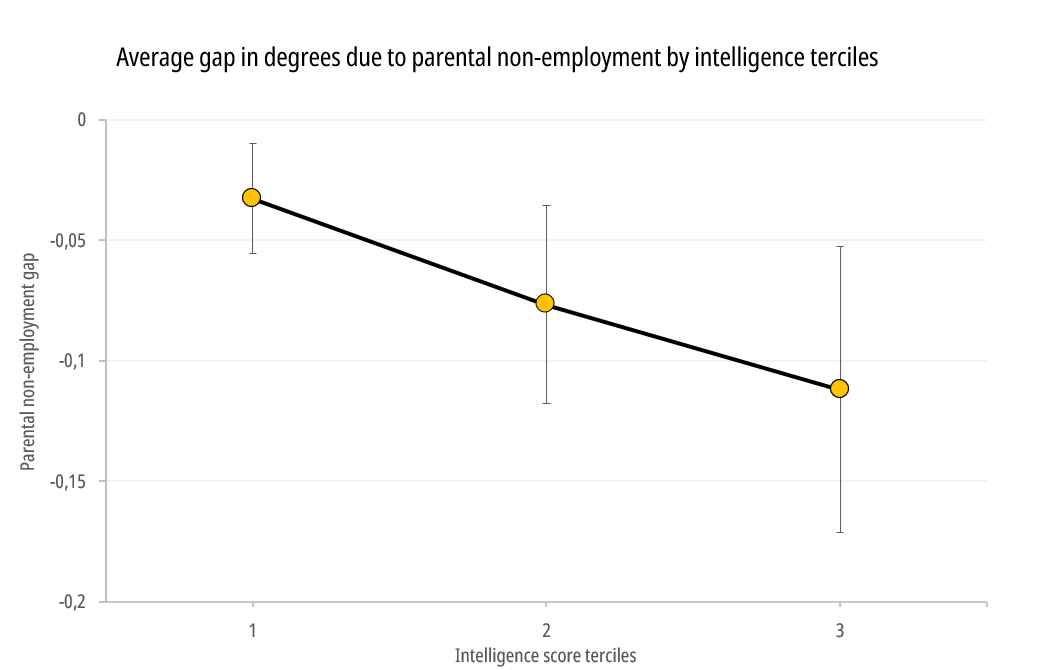
The study finds that higher intelligence widens the gap in educational outcomes due to non-working parents but narrows the gap in labour-market outcomes. The gap in years of schooling increases on average by 0.8 months for every one standard deviation increase in intelligence score, and the gap in tertiary degree attainment widens by 3.6 percentage points per standard deviation.
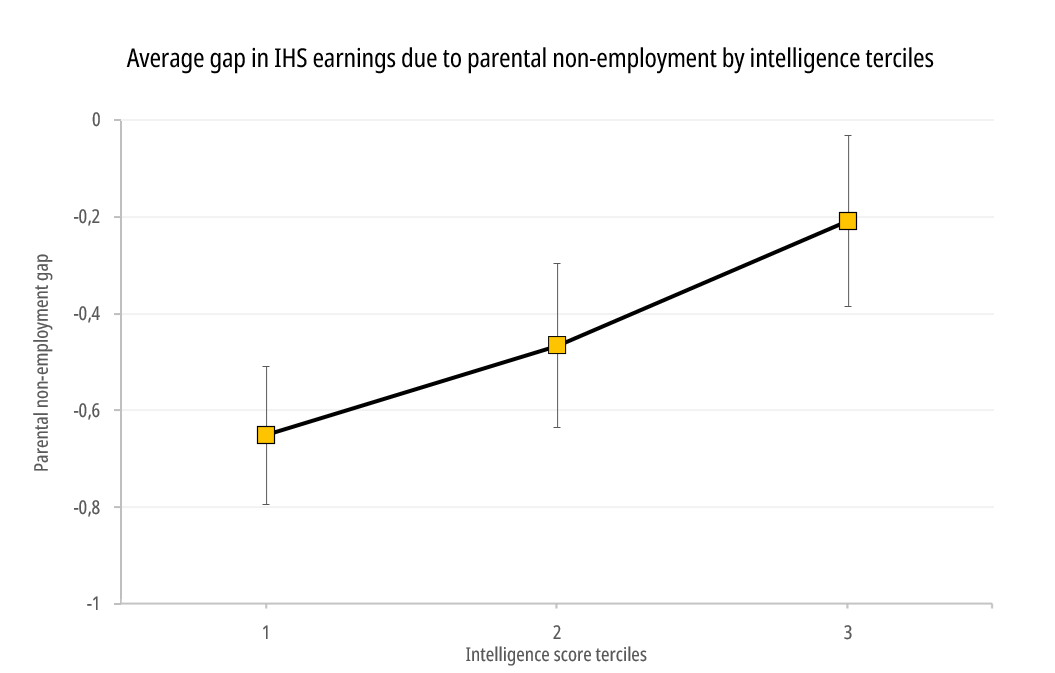
In contrast, in the labour market, a one standard deviation increase in intelligence score narrows the gap from parental non-employment on children’s employment by 4.8 percentage points and on earnings by 0.13 percentage points. This suggests that higher intelligence mitigates the potentially negative effects of parental non-employment in the longer term.
Overall, the findings indicate that although higher intelligence is associated with larger educational losses following parental non-employment, it enables children to overcome these disadvantages over time in the labour market. The results suggest that loss of human capital investments into children is the key driving mechanism.
The article Does intelligence shield children from the effects of parental non-employment? has been published in Economics of Education Review in January 2025.


