Income rank information matters most when it’s about peers
A recent study by Xiaogeng Xu, Satu Metsälampi, Michael Kirchler, Kaisa Kotakorpi, Peter Hans Matthews, and Topi Miettinen examines which income comparisons matter most for people’s wellbeing.
A study by Xiaogeng Xu, Satu Metsälampi, Michael Kirchler, Kaisa Kotakorpi, Peter Hans Matthews, and Topi Miettinen examines which income comparisons matter most for people’s wellbeing — occupational peers, educational peers, people of the same age, municipal neighbors, or the nation as a whole.
Relative income is known to shape wellbeing, but it has been unclear which comparison groups matter most. This matters both inside organizations, where comparisons with bosses or colleagues affect incentives and turnover, and in the public sphere, where the choice of comparison group may shape preferences over redistribution.
The researchers invited a representative sample of 20,000 mid-career Finns aged 35–45 to a pre-registered information experiment, in cooperation with Statistics Finland; about 6,600 responded. Participants first reported their incentivized beliefs about their income rank within five reference groups that could be measured using register and survey data — occupation, age cohort, education, municipality, and the whole country. They were then randomly informed of their true rank in just one of these groups, or received no information at all.
Learning one’s income rank affected satisfaction with income, wages, and perceived fairness of income — but only when the reference group was narrow: occupational peers, educational peers, or people of the same age. Information about rank in the national income distribution had little effect.
The effects went beyond self-reported wellbeing. Using linked administrative register data, the researchers found that people who learned that their occupational rank was lower than expected went on to earn more in 2021, the year of the study. When given a choice of which rank to learn, participants overwhelmingly chose to find out their standing among people in the same occupation rather than in the country as a whole — further evidence that narrow comparison groups are what people care about.
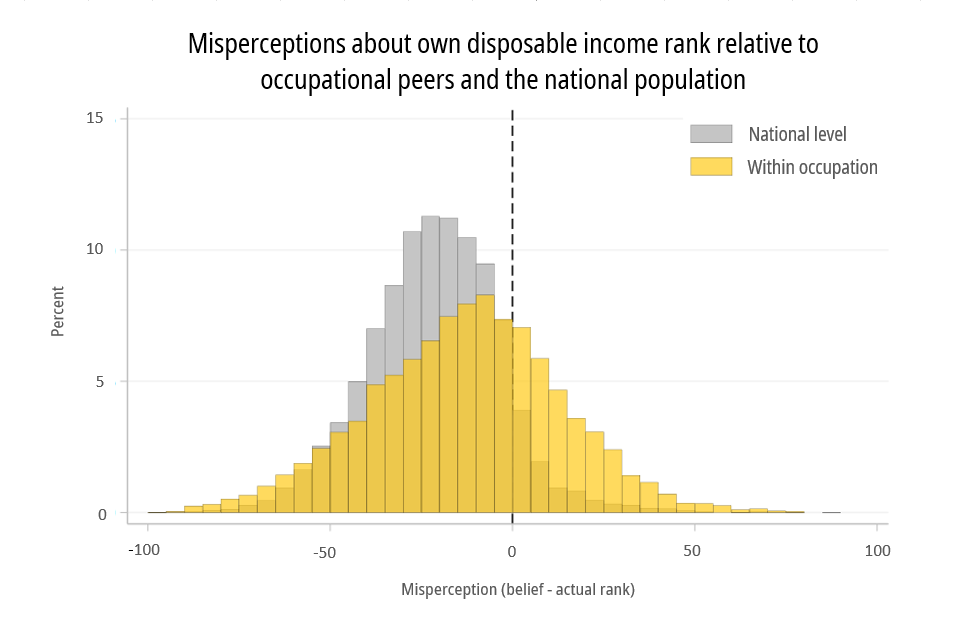
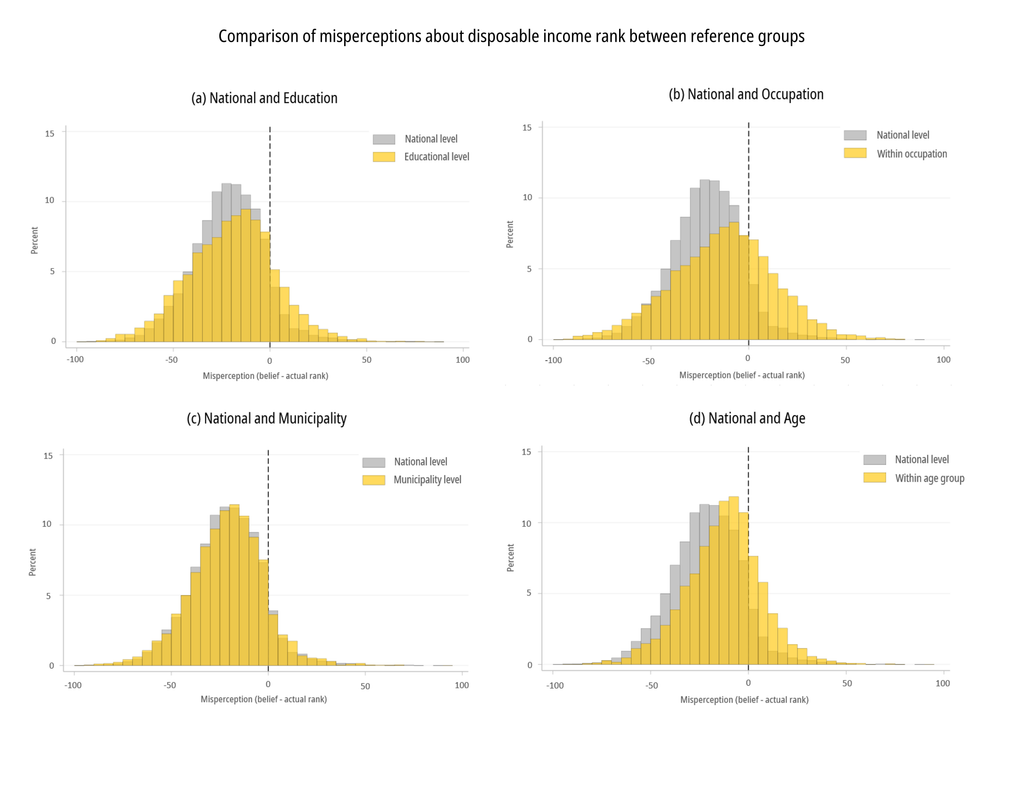
The study also shows that participants greatly underestimate their relative standing across all the comparison groups studied, with the largest misperceptions concerning their rank nationally and within their home municipality. The findings suggest that income transparency policies may do more good than a focus on national inequality alone would imply: because more people underestimate their income rank than overestimate it, providing rank information could raise aggregate wellbeing.
The article Which Reference Groups Matter and How? A Relative Income Information Experiment with Administrative Data has been published in American Economic Journal: Applied Economics in July 2026.


